

Product Information
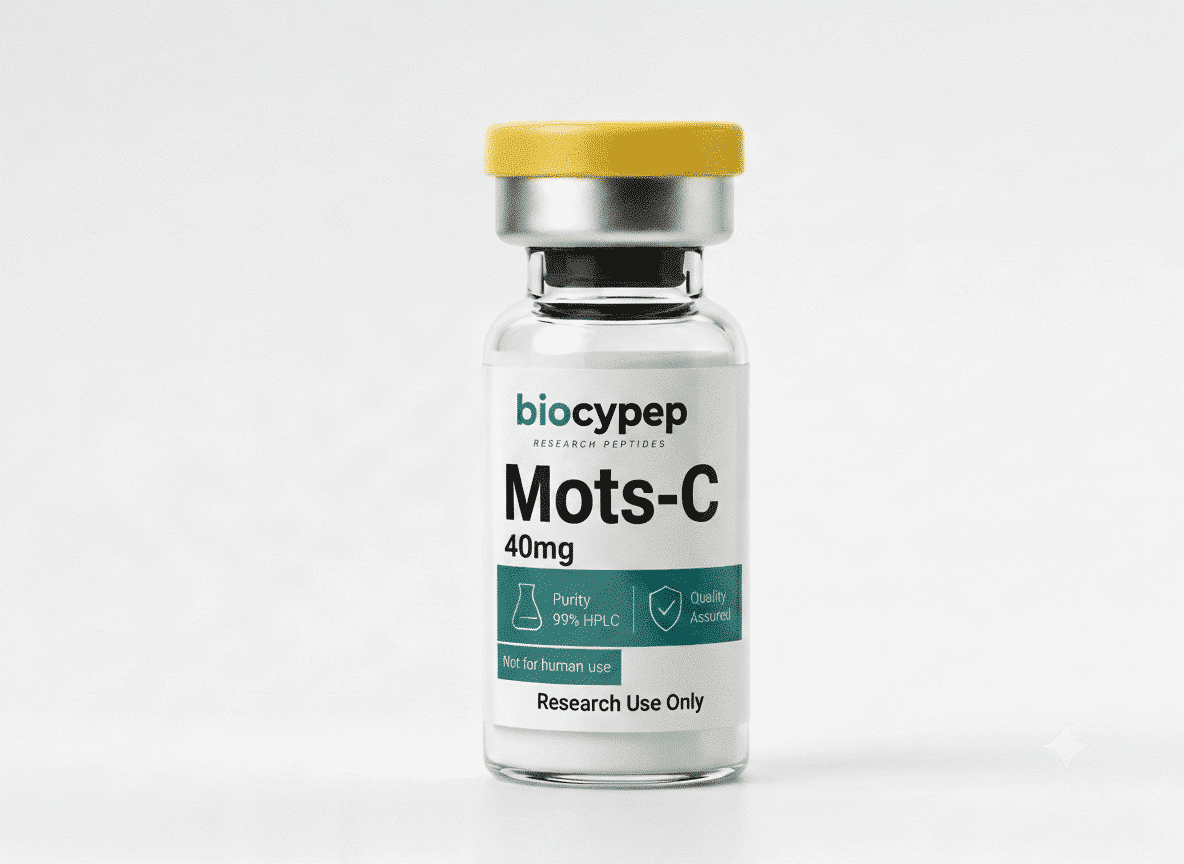
MOTS-c is supplied as a lyophilized powder in a sealed vial. It is intended exclusively for laboratory and research purposes and is not intended for use in humans or animals.
Available testing documentation is organized by product in the laboratory section, keeping product information and testing status traceable.
Short Profile
- Mitochondria-derived peptide
- Studied in research on metabolic homeostasis
- 16-amino-acid peptide
Research Guide · What Is MOTS-c? Structure, Analysis, and Research Handling →
About MOTS-c
What Is MOTS-c?
MOTS-c is a 16-amino-acid peptide classified as a mitochondria-derived peptide (MDP). The name stands for “mitochondrial open reading frame of the 12S rRNA-c” and describes the sequence’s location: it is encoded by a short open reading frame within the 12S rRNA gene of mitochondrial DNA, rather than in the cell nucleus.
The peptide was first described in 2015. MOTS-c is endogenous; the form offered here is synthetically produced and corresponds to the human sequence.
Sequence and Key Characteristics
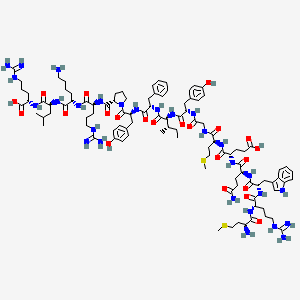
- Sequence: Met-Arg-Trp-Gln-Glu-Met-Gly-Tyr-Ile-Phe-Tyr-Pro-Arg-Lys-Leu-Arg
- One-letter code: MRWQEMGYIFYPRKLR
- Termini: Free N- and C-termini (H-…-OH), without acetylation or amidation
- Molecular formula: C₁₀₁H₁₅₂N₂₈O₂₂S₂
- Molar mass: 2,174.6 g/mol (free peptide, without counterions)
- PubChem CID: 146675088
The C-terminal region is notable: three of the final four residues are basic amino acids (Arg, Lys, Arg), and there is another arginine at position 2. The molecule therefore carries a net positive charge at neutral pH. The two sulfur atoms in the molecular formula come from the methionine residues at positions 1 and 6.
Research Context
MOTS-c is studied in cell cultures and rodent models in relation to metabolic homeostasis, with a focus on skeletal muscle tissue. A classical membrane receptor has not yet been identified.
The study that first described the peptide linked its cellular activity to inhibition of the folate cycle and the associated de novo purine biosynthesis, followed by activation of AMP-activated protein kinase (AMPK). Accordingly, some research examines communication between mitochondria and the cell nucleus through folate- and AMPK-related pathways.
Analytical Testing
MOTS-c is supplied in a 40 mg vial, with a listed purity of ≥98% by HPLC. Mass spectrometry compares the measured mass with the value calculated from the molecular formula C₁₀₁H₁₅₂N₂₈O₂₂S₂: approximately 2,173.11 Da monoisotopic mass or 2,174.6 Da average mass.
Because the peptide contains four basic residues, its mass spectrum shows multiple charge states, which are combined through deconvolution to determine the molecular mass. Signals 16 Da above the target mass may indicate oxidized methionine, a common secondary component in methionine-containing sequences.
The peptide is regularly tested externally by HPLC and mass spectrometry at an independent laboratory. Available certificates of analysis (COAs) are provided in the laboratory section. If no certificate is posted for MOTS-c, testing is listed as pending. The Quality Control guide describes the associated testing procedures.
Specifications
| Specification |
Details
|
|---|---|
| Form | Lyophilized powder |
| Database | PubChem |
| Purity | ≥98% |
| Testing methods | HPLC / MS |
| Quantity | 40 mg |
| Category | Mitochondrial Peptides |
| Catalogue number | — |
Intended Use
For research use only. All products are intended exclusively for scientific in-vitro research and are not intended for human or veterinary use.