Product Information
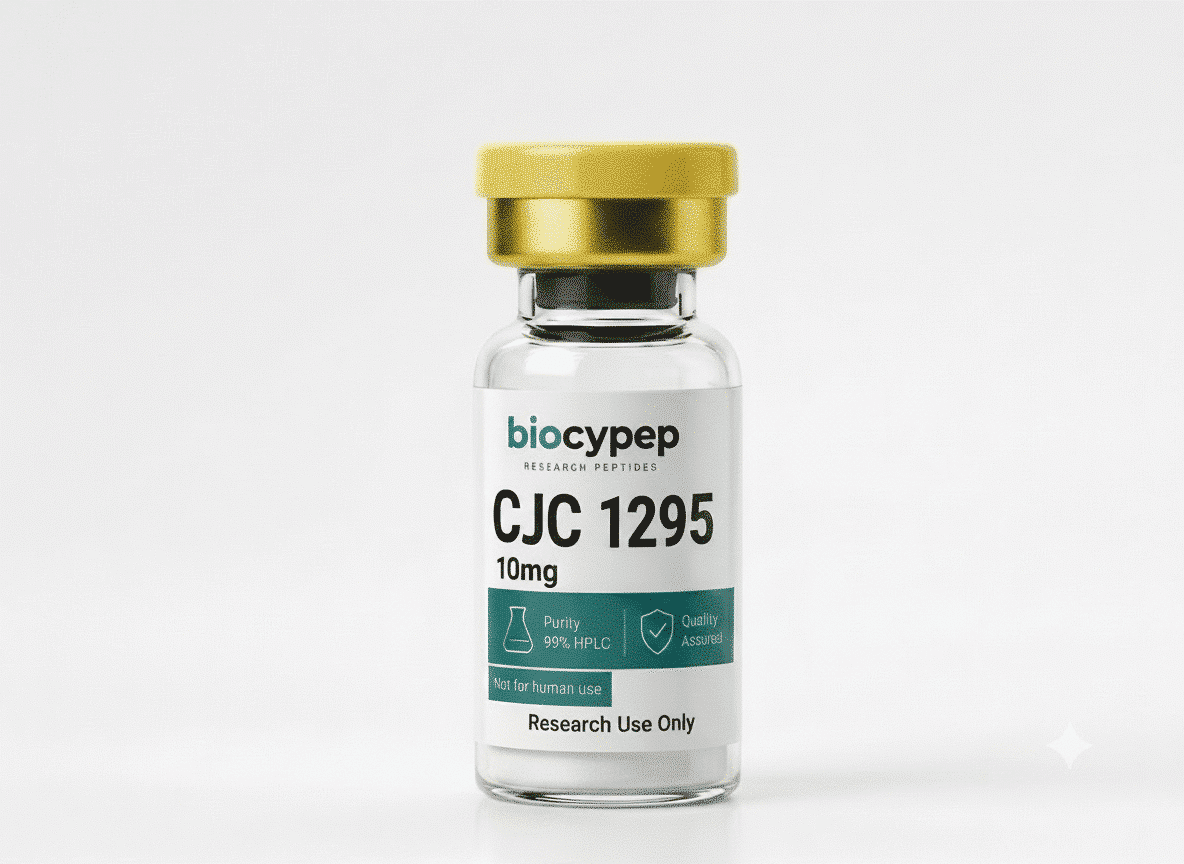
CJC-1295 (No DAC) is supplied as a lyophilized powder in a sealed vial. It is intended exclusively for laboratory and research purposes and is not intended for use in humans or animals.
Available testing documentation is organized by product in the laboratory section, keeping product information and testing status clearly traceable.
Short Profile
- Modified GRF (1-29)
- No Drug Affinity Complex (DAC)
- GHRH receptor research
Research Guide · CJC-1295 and Ipamorelin: Structure, Analysis, and Research Handling →
About CJC-1295 (No DAC)
What Is CJC-1295 (No DAC)?
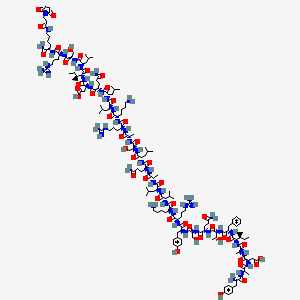
CJC-1295 (No DAC) is a truncated analog of human GHRH. It comprises the first 29 amino acids of the hormone—the GRF(1-29) fragment—with four substitutions. In scientific literature, it is also known as Modified GRF (1-29), or Mod GRF (1-29), and as tetrasubstituted hGRF(1-29). Its systematic shorthand is [D-Ala², Gln⁸, Ala¹⁵, Leu²⁷]-hGRF(1-29)-NH₂.
Pharmacologically, it is classified as an agonist of the pituitary GHRH receptor. “No DAC” is a common commercial label distinguishing this peptide from the compound described in scientific literature as CJC-1295, which additionally contains a Drug Affinity Complex (DAC).
Structure and Key Characteristics
- Sequence (29 amino acids): Y-(D-Ala)-DAIFTQSYRKVLAQLSARKLLQDILSR-NH₂
- Substitutions compared with hGRF(1-29): D-alanine instead of L-alanine at position 2; glutamine instead of asparagine at position 8; alanine instead of glycine at position 15; and leucine instead of methionine at position 27
- Molecular formula: C₁₅₂H₂₅₂N₄₄O₄₂
- Molar mass: 3,367.9 g/mol (free peptide)
- PubChem CID: 56841945
With or Without DAC: What’s the Difference?
The DAC variant has an additional lysine at the C-terminus. Its side chain carries a 3-maleimidopropionamide group that binds to serum albumin. This changes the molecular formula and mass substantially: the DAC form has the formula C₁₆₅H₂₆₉N₄₇O₄₆ and a mass of 3,647.2 g/mol, whereas the No-DAC peptide offered here has a mass of 3,367.9 g/mol.
The CAS number 446262-90-4 also refers to the DAC variant and does not identify this product. The catalogue offers the No-DAC form as a standalone compound; the DAC form is not offered as a standalone product.
Related Peptides
Tesamorelin is also a GHRH analog, but differs in both length and type of modification. Its full, natural 44-residue chain is retained, with an additional hexenoyl group at the N-terminus. CJC-1295 (No DAC), by contrast, has a shortened and modified sequence.
The sequence comparison illustrates the difference: at positions 2, 8, 15, and 27, tesamorelin has the natural residues alanine, asparagine, glycine, and methionine. CJC-1295 (No DAC) has D-alanine, glutamine, alanine, and leucine at those positions.
Research Context
As a modified hGRF(1-29), the peptide is studied in research on the pituitary GH axis and pulsatile GH secretion, including studies using cultured anterior pituitary cells and rodent models.
Analytical Testing
CJC-1295 (No DAC) is regularly tested externally using HPLC and mass spectrometry. Because commercial naming is inconsistent, mass is a key marker for confirming identity: at approximately 3,368 Da, the peptide is about 279 Da lighter than the DAC variant, making a mix-up readily apparent in the mass spectrum.
With electrospray ionization, it typically appears as a triply or quadruply charged ion, at calculated m/z values of approximately 1,124 and 843, respectively. Because position 27 contains leucine rather than methionine, the sequence contains no sulfur, so methionine oxidation is not a relevant potential by-product.
Specifications
| Specification |
Details
|
|---|---|
| Form | Lyophilized powder |
| Purity | ≥98% |
| Testing methods | HPLC / MS |
| Quantity | 10 mg |
| Category | GHRH & GHRP |
| Catalogue number |
Intended Use
For research use only. All products are intended exclusively for scientific in-vitro research and are not intended for human or veterinary use.