Product Information
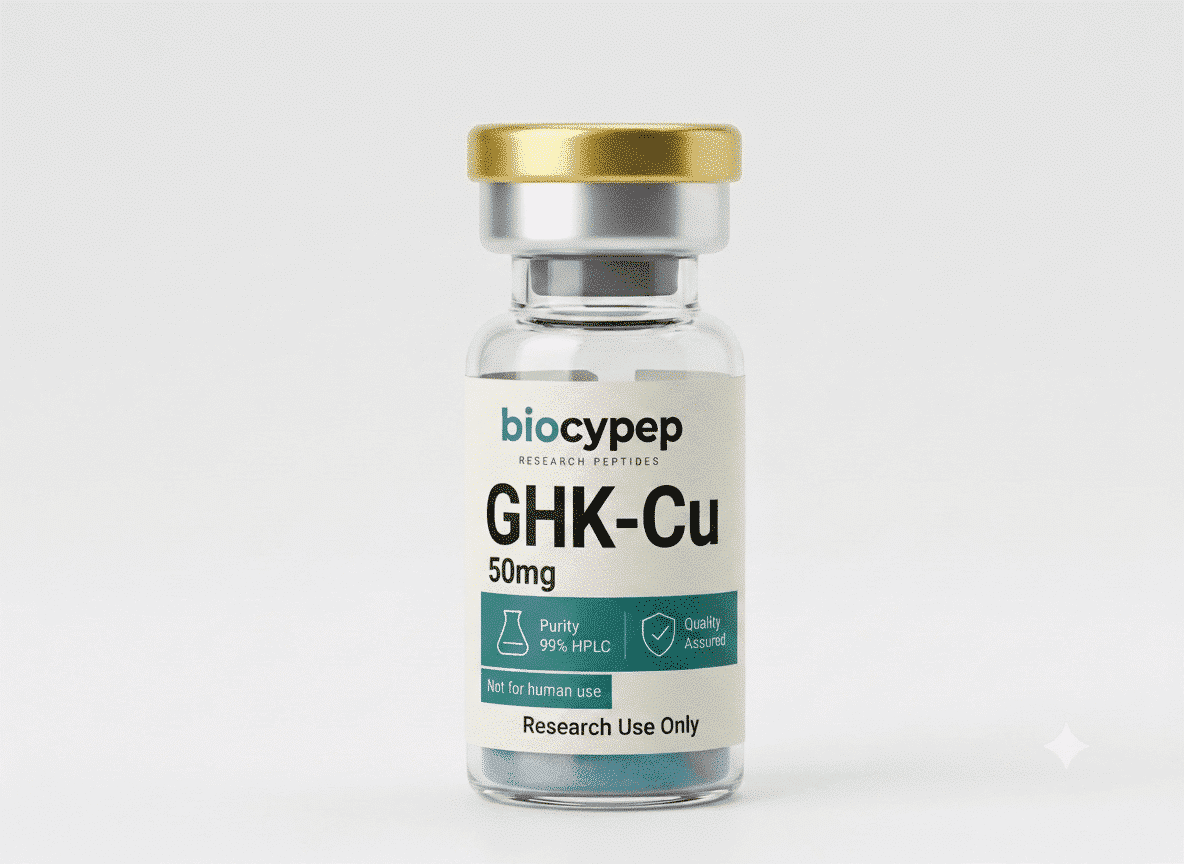
GHK-Cu is supplied as a lyophilized powder in a sealed vial. It is intended exclusively for laboratory and research purposes and is not intended for use in humans or animals.
Available testing documents are organized by product in the laboratory section, keeping product information and testing status traceably linked.
Short Profile
- Copper tripeptide (GHK-Cu)
- Studied in research on collagen-related pathways
- 50 mg per vial
What Is GHK-Cu?
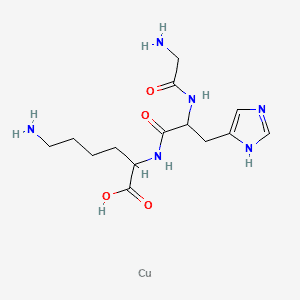
GHK-Cu is a complex of the tripeptide glycyl-L-histidyl-L-lysine (GHK) and a copper(II) ion. It is also known as Copper Tripeptide-1, prezatide copper, and Cu(II)-GHK.
The tripeptide occurs naturally in human blood plasma, where it has been isolated as a component and forms a chelate complex with copper(II) ions. The product listed in the catalogue is synthetically produced.
Chemical Structure and Key Properties
The peptide itself is short: glycine, histidine, and lysine linked as H-Gly-L-His-L-Lys-OH, with free amino and carboxyl termini. This tripeptide binds the copper(II) ion to form a chelate complex.
Unlike hormone analogues, GHK-Cu is not associated with a single classical receptor. The relevant specifications depend on which form is being described:
- Free peptide GHK: C₁₄H₂₄N₆O₄, 340.38 g/mol, CAS 49557-75-7, PubChem CID 73587
- Neutral 1:1 copper complex: C₁₄H₂₂CuN₆O₄, approximately 401.9 g/mol
- Copper complex (prezatide copper): CAS 89030-95-5, PubChem CID 71587328
In product information, the CAS numbers for free GHK and the copper complex are often confused: 49557-75-7 refers to the copper-free tripeptide, while 89030-95-5 refers to the copper complex. Entries also exist for a 2:1 bis-complex and for an acetate form with a considerably higher molar mass. The exact value therefore depends on the stoichiometry and counterion.
Research Context
GHK-Cu is studied primarily in in-vitro models using fibroblasts and other cell cultures, as well as in preclinical research on copper-peptide chemistry. Research areas include copper binding and delivery, the synthesis of extracellular matrix components—collagen, elastin, and glycosaminoglycans—and gene-expression patterns associated with GHK.
Analytical Testing
The vial contains 50 mg, with a listed purity of ≥98% by HPLC. For identity testing by mass spectrometry, the mass of the GHK tripeptide is the primary reference: C₁₄H₂₄N₆O₄, approximately 340.19 Da monoisotopic mass.
Whether copper-containing signals are also observed depends on the ionization and measurement conditions. Copper has two stable isotopes, so such signals show a characteristic isotope pattern.
GHK-Cu is regularly tested by an independent external laboratory using HPLC and mass spectrometry. Available certificates of analysis (COAs) are published in the laboratory section; if no certificate is listed there, testing is considered pending. The guide Purity of Research Peptides explains what a purity percentage does—and does not—indicate.
Specifications
| Specification |
Details
|
|---|---|
| Form | Lyophilized powder |
| Database | PubChem |
| Purity | ≥98% |
| Testing methods | HPLC / MS |
| Quantity | 50 mg |
| Category | Melanocortins & Copper Peptides |
| Catalogue number |
Intended Use
For research use only. All products are intended exclusively for scientific in-vitro research and are not intended for human or veterinary use.