Product Information
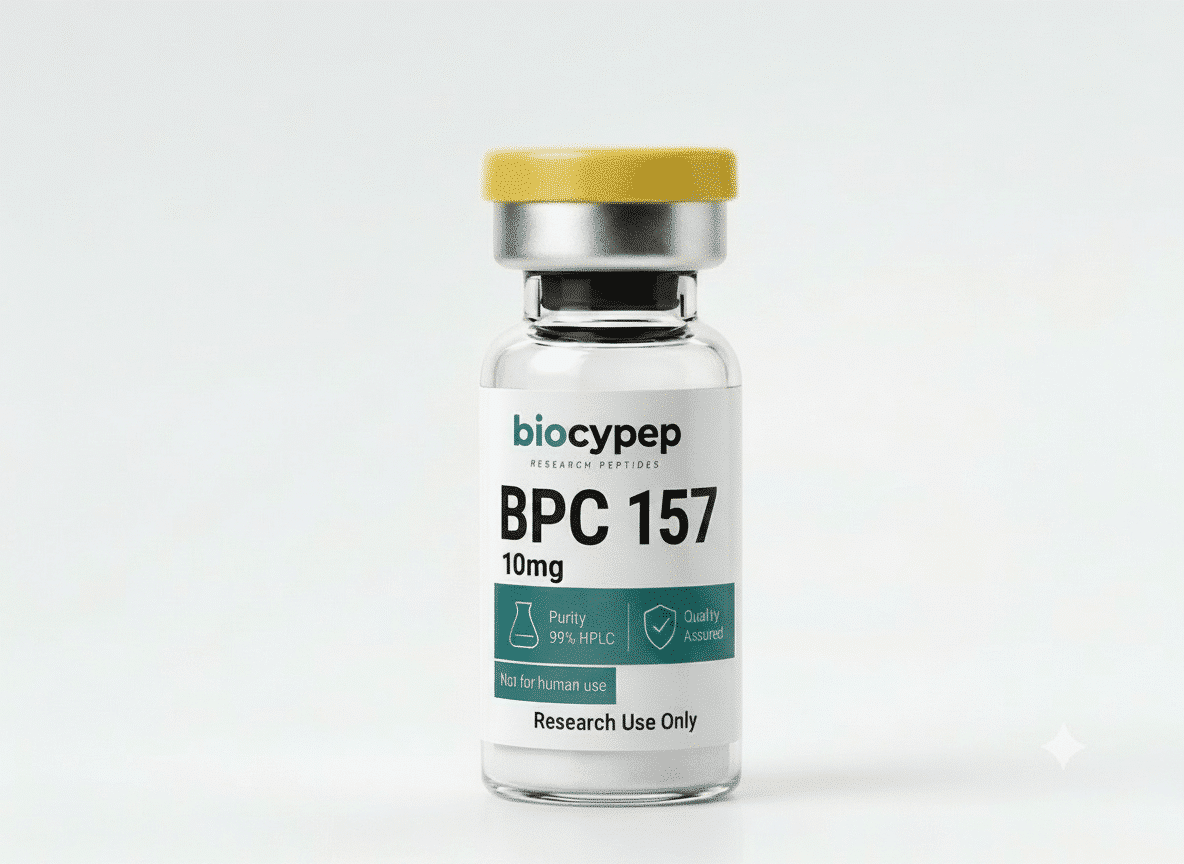
BPC-157 is supplied as a lyophilized powder in a sealed vial. It is intended exclusively for laboratory and research purposes and is not intended for use in humans or animals.
Available testing documentation is organized by product in the laboratory section, keeping product information and testing status clearly traceable.
Short Profile
- Pentadecapeptide (15 amino acids)
- Studied in research on angiogenesis and tissue regeneration
- Highly stable in lyophilized form
Research Guide · What Is BPC-157? Structure, Analysis, and Research Handling →
About BPC-157
What Is BPC-157?
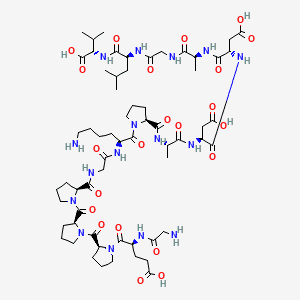
BPC-157 is a fully synthetic, linear peptide consisting of 15 amino acids—a pentadecapeptide. The abbreviation stands for “Body Protection Compound 157.” In databases and scientific publications, the substance also appears as BPC-157 or “Gastric Pentadecapeptide BPC-157.”
The sequence is described in the literature as a fragment of a protein reportedly isolated from human gastric juice and referred to as Body Protection Compound. However, no sequence for this proposed source protein has been publicly reported, so the stated origin is based solely on descriptions in the scientific literature. PubChem lists the peptide under synonyms that include “Gastric Juice Peptide Fragment.”
Structure and Key Characteristics
- Sequence: H-Gly-Glu-Pro-Pro-Pro-Gly-Lys-Pro-Ala-Asp-Asp-Ala-Gly-Leu-Val-OH
One-letter code: GEPPPGKPADDAGLV - Structure: 15 amino acids, linear, with free N- and C-termini
- Molecular formula: C₆₂H₉₈N₁₆O₂₂
- Molar mass: 1,419.5 g/mol (average); monoisotopic mass: 1,418.70 Da
- CAS number: 137525-51-0
- PubChem CID: 9941957
The formula and masses refer to the free peptide without counterions. Structurally, BPC-157 has a high proline content: four of its 15 positions are occupied by proline, including three consecutive residues at positions 3–5. It also contains three acidic residues—one glutamate and two aspartates—and one basic side chain, from lysine.
Research Context
A defined receptor or other molecular target protein has not yet been identified for BPC-157; its mechanism remains unclear in the scientific literature. Research has focused primarily on signaling pathways related to angiogenesis and cell migration.
Specifications
| Specification |
Details
|
|---|---|
| Form | Lyophilized powder |
| Database | PubChem |
| Purity | ≥98% |
| Testing methods | HPLC / MS |
| Quantity | 15 mg |
| Category | Peptide Fragments |
| Catalogue number |
Intended Use
For research use only. All products are intended exclusively for scientific in-vitro research and are not intended for human or veterinary use.