Product Information
Cagrilintide is a long-acting, acylated amylin analog developed by Novo Nordisk. It acts as an agonist at amylin receptor complexes (AMY1–AMY3) and at the calcitonin receptor. The compound is investigated in research on satiety signaling and energy homeostasis, including studies in combination with GLP-1 receptor agonists.
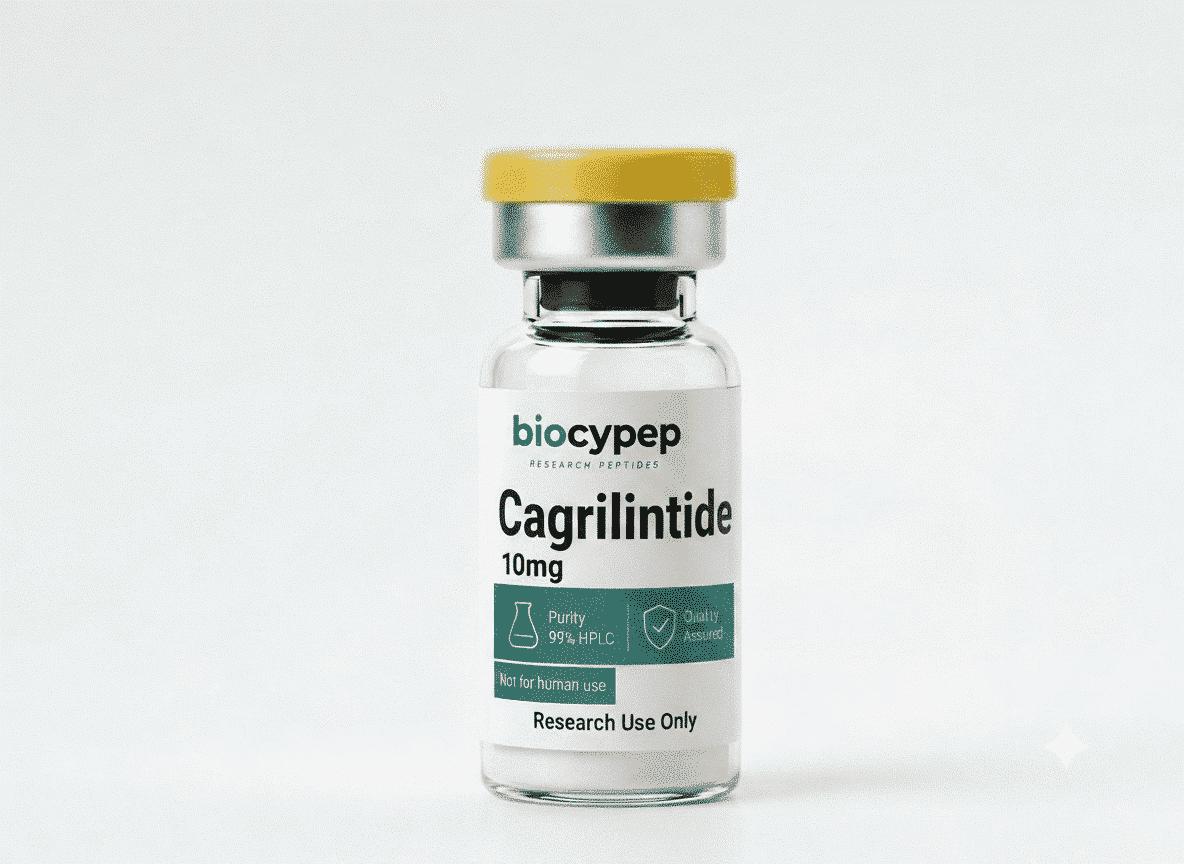
Cagrilintide is supplied as a lyophilized powder in a sealed vial. It is intended exclusively for laboratory and research purposes and is not intended for use in humans or animals.
Available testing documentation is organized by product in the laboratory section, allowing the product information and corresponding testing status to remain clearly traceable.
Research Guide · What Is Cagrilintide? Structure, Analysis, and Research Handling →
About Cagrilintide
What is Cagrilintide?
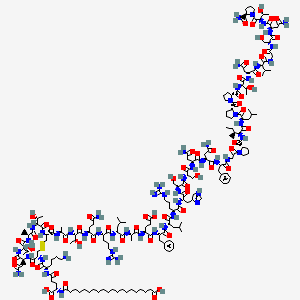
Cagrilintide is the International Nonproprietary Name (INN) of a synthetic peptide. It belongs to the class of amylin analogs and consists of a 37-amino-acid chain based on human amylin (IAPP), with several structural modifications and lipidation.
Pharmacologically, cagrilintide is characterized as a non-selective agonist at the amylin receptor complexes AMY1, AMY2, and AMY3, as well as at the calcitonin receptor (CTR). These amylin receptors consist of the calcitonin receptor combined with one of three receptor activity-modifying proteins: RAMP1, RAMP2, or RAMP3.
Structure and Key Characteristics
Compared with human amylin, cagrilintide contains glutamic acid at position 14 and arginine at position 17. This residue pair is designed to support a helix-stabilizing salt bridge. Additional proline residues are present at positions 25, 28, 29, and 37.
A 20-carbon fatty acid is attached to the amino group of Lys1 through an L-γ-glutamyl linker. The C-terminus is amidated.
- Peptide sequence, 37 amino acids: KCNTATCATQ RLAEFLRHSS NNFGPILPPT NVGSNTP
- Structural modifications: HOOC-(CH₂)₁₈-CO-γGlu attached to Lys1; C-terminal prolinamide; disulfide bridge between Cys2 and Cys7
- Molecular formula: C₁₉₄H₃₁₂N₅₄O₅₉S₂
- Molecular weight: 4,409.1 g/mol, excluding counterions
- Monoisotopic mass: 4,406.25 Da
- CAS Registry Number: 1415456-99-3
- PubChem CID: 171397054
Chemical identifiers and physicochemical specifications should be verified against the applicable batch documentation before publication.
Research Context
Cagrilintide is investigated in in-vitro and preclinical research involving the amylin and calcitonin receptor systems. Because the molecule can interact with the calcitonin receptor itself as well as with AMY1, AMY2, and AMY3 receptor complexes, it may be used in research examining how different RAMP subunits influence ligand recognition and receptor signaling.
This information describes a research subject and does not constitute a claim regarding effects in humans or animals.
Analytical Testing
The vial contains 10 mg of lyophilized peptide with a stated purity of ≥98%, where confirmed by the applicable batch-specific documentation.
Cagrilintide may be analyzed by external laboratories using reverse-phase HPLC and mass spectrometry. In reverse-phase HPLC, the C20 lipid side chain contributes to increased hydrophobicity and may extend the molecule’s retention time. Purity is generally assessed based on the relative area of the principal chromatographic peak.
Following electrospray ionization, multiply protonated ions may be observed. Based on the average molecular mass, the calculated m/z values are approximately:
- m/z 1,470.7 for the 3+ ion
- m/z 1,103.3 for the 4+ ion
- m/z 882.8 for the 5+ ion
At approximately 4.4 kDa, the monoisotopic signal may be less intense than the dominant isotopic peak. Removal of the fatty-acid–γGlu side chain would reduce the average molecular mass by approximately 453.6 Da. Opening of the disulfide bridge would increase the mass by approximately 2 Da; this difference generally requires sufficiently high-resolution mass spectrometry for reliable confirmation.
Specifications
| Specification |
Details
|
|---|---|
| Form | Lyophilized powder |
| Purity | ≥98%, where confirmed by batch-specific analysis |
| Analytical methods | HPLC / MS |
| Quantity | 10 mg |
| Category | Amylin analogs |
| Catalogue number |
Intended Use
For research use only.
This product is intended exclusively for scientific in-vitro laboratory research. It is not approved for, intended for, or suitable for human or veterinary use. It must not be used for consumption, self-administration, diagnosis, treatment, prevention, or any other clinical or therapeutic purpose.