Product Information
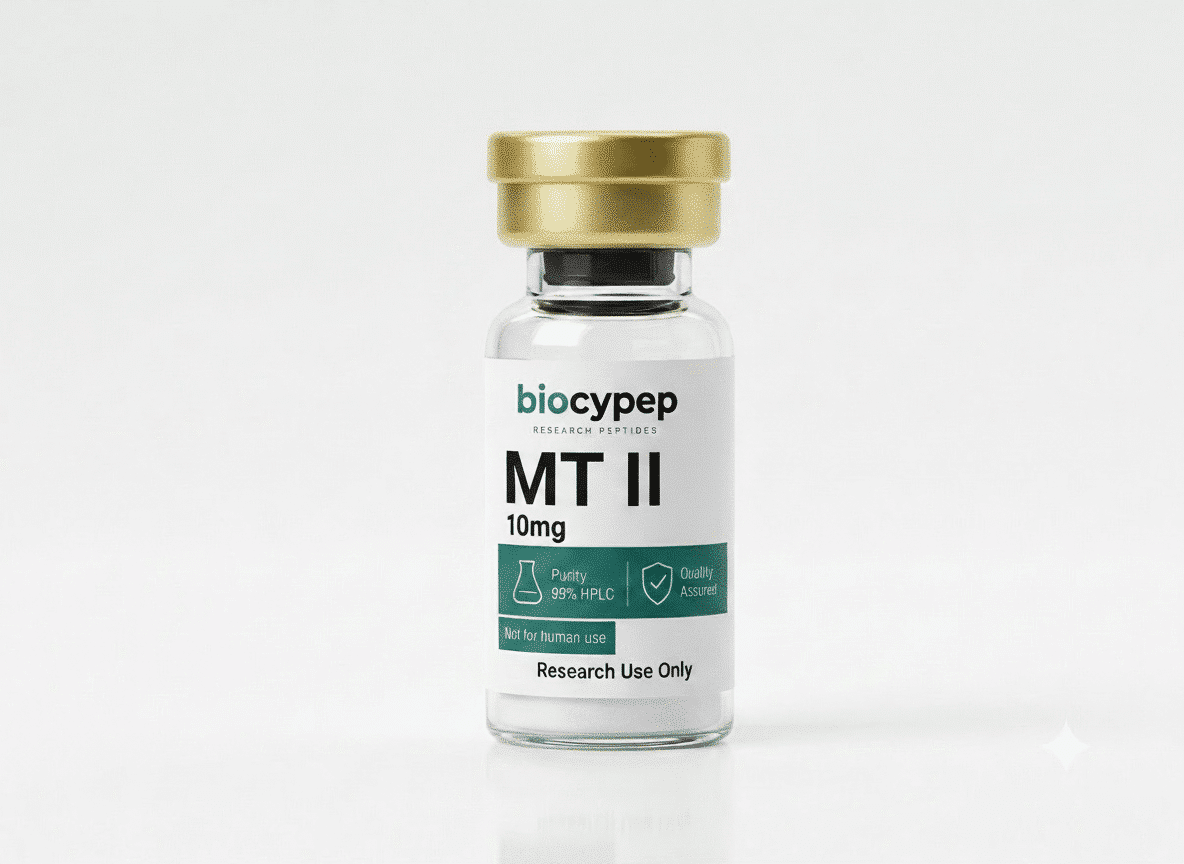
Melanotan II (MT2) is supplied as a lyophilized powder in a sealed vial. It is intended exclusively for laboratory and research purposes and is not intended for use in humans or animals.
Available testing documentation is organized by product in the laboratory section, keeping product information and testing status traceable.
Short Profile
α-MSH analog
Used in melanocortin receptor research
Cyclic heptapeptide
Research Guide · Melanotan II and Melanotan I: Structure, Analysis, and Research Handling →
About Melanotan II (MT2)
What Is MT2?
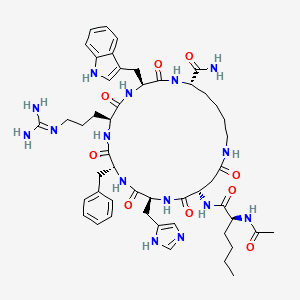
MT II is the catalogue name for Melanotan II, also referred to in the literature as MT II or Melanotan-II. It is a fully synthetic, cyclic peptide in the melanocortin family. Its scaffold is derived from the core region, residues 4–10, of α-melanocyte-stimulating hormone (α-MSH), which has a natural sequence of 13 amino acids.
Pharmacologically, Melanotan II is classified as a non-selective agonist of melanocortin receptors: it acts on several subtypes within this receptor family rather than selectively targeting a single one.
Structure and Key Characteristics
MT II is derived from the α-MSH core region through four substitutions: norleucine at position 4, aspartic acid at position 5, D-phenylalanine at position 7, and lysine at position 10. The side chains of aspartic acid and lysine are linked by an amide bond, known as a lactam bridge. This forms a ring of six amino acids, preceded by acetylated norleucine; the C-terminus is amidated.
Sequence: Ac-Nle-cyclo[Asp-His-D-Phe-Arg-Trp-Lys]-NH₂
One-letter code of the core: XDHfRWK (X = norleucine, f = D-phenylalanine)
Molecular formula: C₅₀H₆₉N₁₅O₉
Molar mass: 1,024.2 g/mol (free form, without counterions)
CAS number: 121062-08-6
PubChem CID: 92432
MT II and Related Peptides
The same catalogue section includes MT1 (Melanotan I). Both peptides are derived from α-MSH, but their structures differ substantially: MT1 is a linear chain of 13 amino acids with only two substitutions from the natural sequence, whereas MT II is shortened to seven residues and constrained into a ring by the lactam bridge.
In the literature, MT1 is associated with the MC1 receptor, while MT II is described as a non-selective agonist acting across several receptor subtypes. KPV, the C-terminal tripeptide Lys-Pro-Val, is also derived from the α-MSH sequence; this segment is absent from MT2. The Melanocortins & Copper Peptides category provides an overview of the molecules in this group.
Research Context
Melanotan II is used in in-vitro and preclinical research as a tool for studying the melanocortin system. At the cellular level, this may include MC1 receptor signaling in melanocyte cultures; in rodent models, research may examine central signaling pathways involving MC4 and MC3 receptors.
Because the compound acts on multiple receptor subtypes, it is used in studies involving knockout lines for individual receptors, such as MC3R or MC4R, as a non-selective reference agonist. Comparing wild-type and knockout models can help determine which part of a signal depends on a particular receptor.
Analytical Testing
MT II is listed as a 10 mg vial with a purity of ≥98% by HPLC. Ideally, the chromatogram is dominated by a single main peak; secondary peaks may indicate, for example, truncated sequences or incompletely cyclized precursors.
Mass spectrometry checks identity against the molecular formula C₅₀H₆₉N₁₅O₉. The expected monoisotopic mass is approximately 1,023.54 Da, with an average mass of approximately 1,024.2 Da. Because the lactam bridge forms through the loss of water, an open-chain precursor is approximately 18 Da heavier—a difference that can be detected by mass spectrometry.
MT2 is regularly tested externally by HPLC and mass spectrometry at an independent laboratory. Available certificates of analysis (COAs) are provided in the laboratory section; if no certificate is posted, testing is listed as pending. The guide to HPLC and mass spectrometry explains how to interpret chromatograms and mass spectra.
Specifications
For research use only. Not for human or veterinary use.