



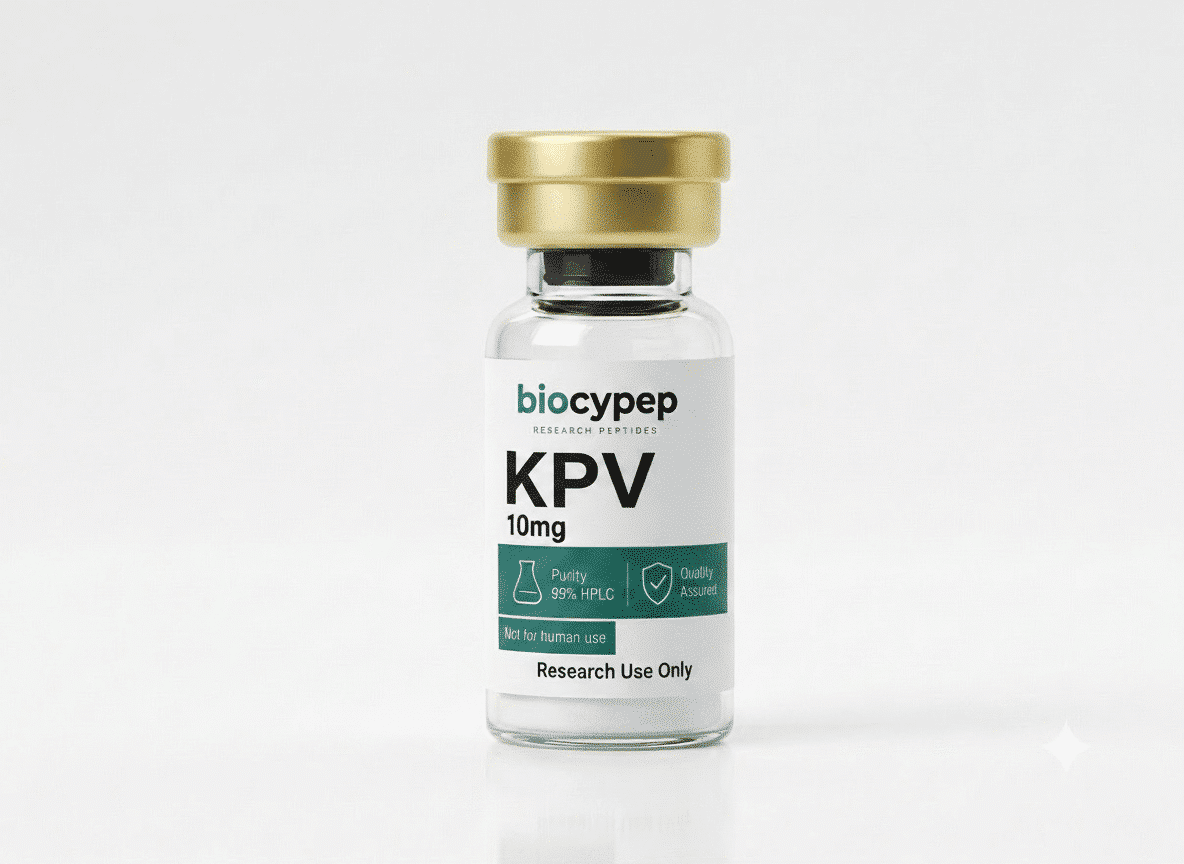
Product Information
KPV is supplied as a lyophilized powder in a sealed vial. It is intended exclusively for laboratory and research purposes and is not intended for use in humans or animals.
Available testing documents are listed by product in the laboratory section, keeping product information and testing status traceable.
Short Profile
- Tripeptide (Lys-Pro-Val)
- α-MSH fragment
- Lyophilized, ≥98% purity
About KPV
What Is KPV?
KPV is a tripeptide consisting of L-lysine, L-proline, and L-valine. Its name comes from the one-letter codes for these three amino acids. The sequence forms the C-terminal end of α-melanocyte-stimulating hormone (α-MSH), which is derived from the precursor protein proopiomelanocortin (POMC), and corresponds to positions 11–13. In the literature, KPV is therefore also referred to as α-MSH (11–13) or α-melanotropin (11–13). The same motif occurs at positions 11–13 of ACTH, so the name ACTH (11–13) is also used.
Structure and Key Properties
- Sequence: H-Lys-Pro-Val-OH (L-lysyl-L-prolyl-L-valine)
- Molecular formula: C₁₆H₃₀N₄O₄
- Molar mass: 342.43 g/mol (average); monoisotopic mass 342.23 Da
- CAS number: 67727-97-3
- PubChem CID: 125672
These database values describe KPV as the free acid with unmodified termini. In native α-MSH, with the sequence SYSMEHFRWGKPV, the termini are modified: the serine at position 1 is acetylated, and the valine at position 13 is amidated. When searching PubChem, use CID 125672, as searching for “KPV” by name alone returns an unrelated compound.
Research Context
As a tripeptide, KPV is a substrate of the di- and tripeptide transporter PepT1 (gene SLC15A1). The literature describes its uptake via this transporter in intestinal epithelial and immune cells.
Research on KPV focuses primarily on pathways involving NF-κB and MAP kinases. Models include intestinal epithelial cell lines such as Caco-2 BBE and HT29-Cl.19A, the Jurkat T-cell line, and preclinical mouse models focused on the intestine. KPV is also discussed as an α-MSH fragment in melanocortin research.
Analytical Testing
For the free-acid form, mass spectrometry is expected to show a singly protonated ion signal at approximately m/z 343.2, based on the monoisotopic mass of 342.23 Da. A C-terminally amidated variant, as found in native α-MSH, would be just under 1 Da lighter and can therefore be distinguished from the free acid. HPLC complements this identity information by providing a purity value.
KPV is also regularly tested by an independent external laboratory using HPLC and mass spectrometry. Available certificates of analysis are listed in the laboratory section; products without a published certificate are marked “pending.” The guide How to Read a Certificate of Analysis explains the information included in such a document.
Specifications
Relevant product details—including form, purity, testing method, and intended use—are provided on the product page.


