Product Information
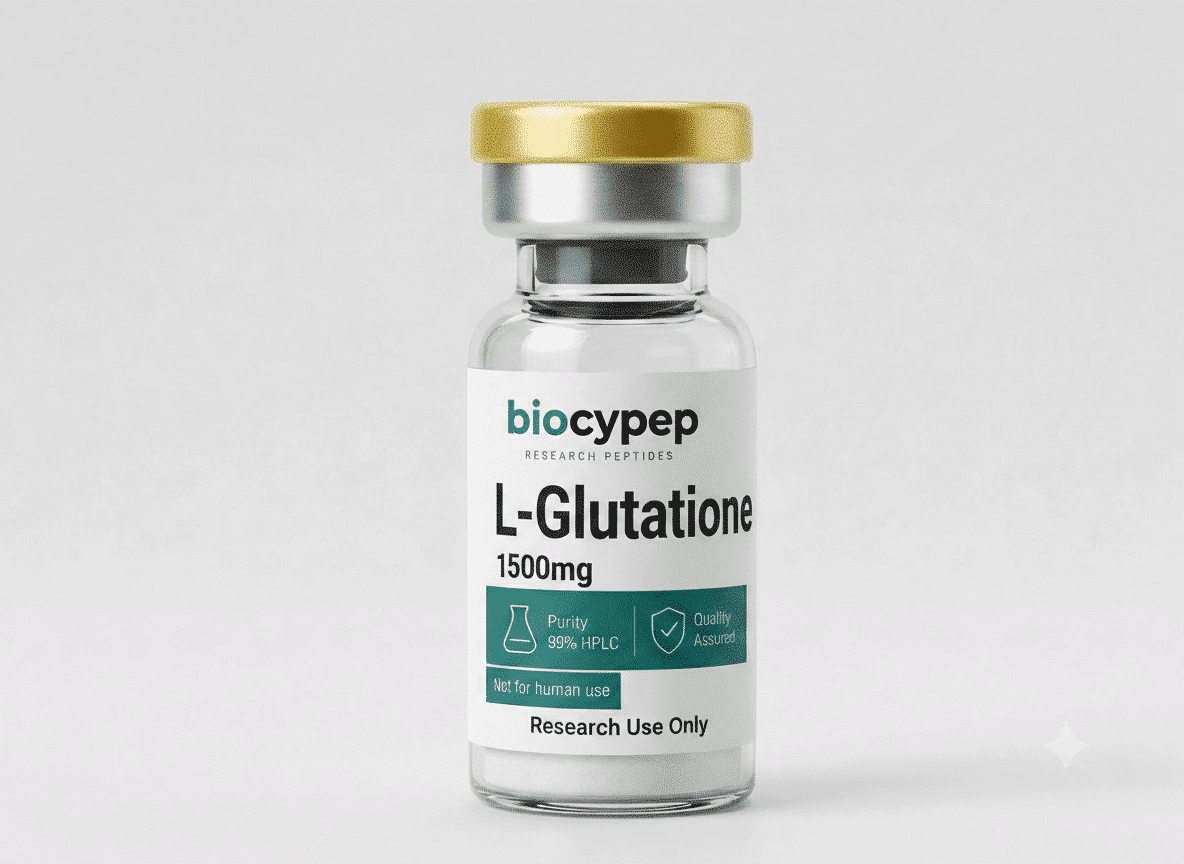
Glutathione is supplied as a lyophilized powder in a sealed vial. It is intended exclusively for laboratory and research purposes and is not intended for use in humans or animals.
Available testing documents are organized by product in the laboratory section, keeping product information and testing status traceably linked.
Short Profile
- Amino acid trimer (Glu-Cys-Gly)
- Studied in research on redox processes
- 600 mg per vial
About Glutathione
What Is Glutathione?
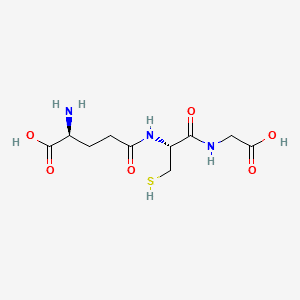
Glutathione, abbreviated GSH and listed in the shop under the English spelling “Glutathione,” is a tripeptide made up of glutamate, cysteine, and glycine.
Glutathione has been identified as a metabolite in humans and in organisms such as the bacterium E. coli. It is considered the most abundant low-molecular-weight thiol in cells. In databases, it is also listed as γ-L-glutamyl-L-cysteinylglycine or simply as reduced glutathione.
Structure and Key Properties
The following values describe the reduced form, with a free thiol group (GSH):
- Sequence: γ-Glu-Cys-Gly
- Molecular formula: C₁₀H₁₇N₃O₆S
- Molar mass: 307.33 g/mol (average); monoisotopic mass 307.08 Da
- CAS number: 70-18-8
- PubChem CID: 124886
- Oxidized form for comparison: glutathione disulfide (GSSG), C₂₀H₃₂N₆O₁₂S₂, 612.6 g/mol, PubChem CID 65359
The bond between glutamate and cysteine is structurally unusual. Unlike a typical peptide bond, it forms through glutamate’s side-chain carboxyl group at the γ-position rather than its α-carboxyl group. This is why the correct shorthand is γ-Glu-Cys-Gly.
Cysteine carries a free thiol group. Two glutathione molecules can link through these groups to form a disulfide, GSSG.
Research Context
In cell biology, glutathione is considered a major low-molecular-weight redox buffer. Its chemical role involves two types of reactions: reducing oxidizing agents, during which GSH is itself oxidized to GSSG, and conjugating with electrophilic compounds.
Glutathione-dependent enzymes, including glutathione peroxidases and glutathione S-transferases, catalyze these reactions. Research examines cellular redox homeostasis, GSH biosynthesis and regulation, and methods for measuring glutathione in samples.
Analytical Testing
In addition to purity, the oxidation state is an important analytical consideration for glutathione because its thiol group can react with oxygen in solution to form the disulfide.
Mass spectrometry clearly distinguishes the two forms: reduced GSH produces a singly protonated signal at approximately m/z 308.1, while the disulfide GSSG has a molar mass of 612.6 g/mol—roughly twice that of GSH. An appropriate HPLC method can separate the two forms, allowing any GSSG content to appear as a distinct peak.
Glutathione is regularly tested by an independent external laboratory using HPLC and mass spectrometry. If a certificate of analysis is available, it can be found in the laboratory section; without a published certificate, the status is shown as “pending.” The guide Quality Control describes the process from raw material to certificate.
Specifications
| Specification |
Details
|
|---|---|
| Form | Lyophilized powder |
| Database | PubChem |
| Purity | ≥98% |
| Testing methods | HPLC / MS |
| Quantity | 1500 mg |
| Category | Redox Peptides |
| Catalogue number |
Intended Use
For research use only. All products are intended exclusively for scientific in-vitro research and are not intended for human or veterinary use.