Product Information
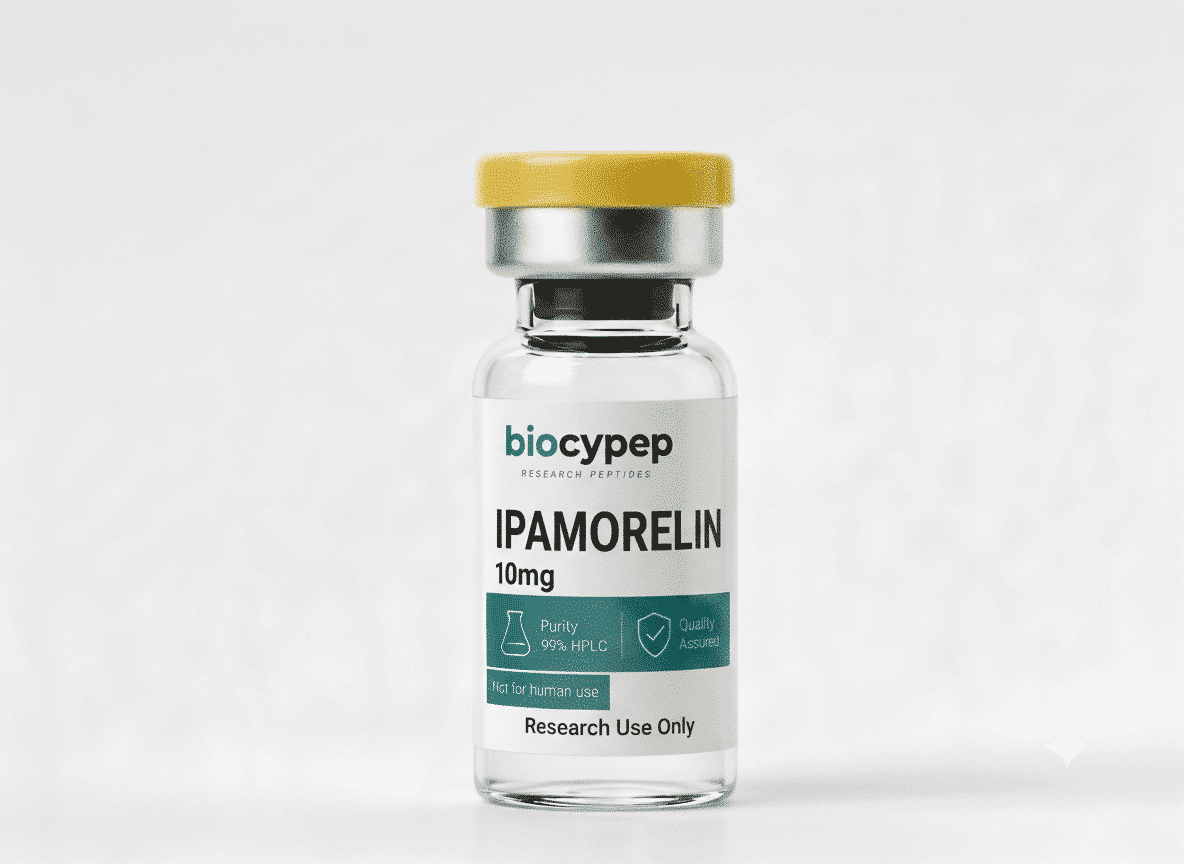
Ipamorelin is supplied as a lyophilized powder in a sealed vial. It is intended exclusively for laboratory and research purposes and is not intended for use in humans or animals.
Available testing documentation is organized by product in the laboratory section, keeping product information and testing status traceable.
Short Profile
- Selective GHRP (pentapeptide)
- Low off-target activity reported in studies
- Purity: ≥99%
Research Guide · CJC-1295 and Ipamorelin: Structure, Analysis, and Research Handling →
About Ipamorelin
What Is Ipamorelin?
Ipamorelin is a synthetic pentapeptide in the growth hormone-releasing peptide (GHRP) class. It is described as a ghrelin mimetic and classified as an agonist of the ghrelin receptor, also known in the literature as the growth hormone secretagogue receptor (GHS-R1a). It was identified in a series of compounds lacking the central Ala-Trp dipeptide found in GHRP-1. Databases also list the research code NNC 26-0161 and the salt name Ipamorelin acetate.
Structure and Key Characteristics
Ipamorelin is the shortest peptide in the GH-related category, with five residues. Three of its five building blocks are not found in this form in natural proteins:
- Sequence: Aib-His-D-2Nal-D-Phe-Lys-NH₂
- Aib: 2-aminoisobutyric acid (2-methylalanine) at the N-terminus
- D-2Nal: 3-(2-naphthyl)-D-alanine, with an aromatic naphthyl side chain
- D-Phe: D-phenylalanine
- C-terminus: Lysinamide
- Molecular formula and mass: C₃₈H₄₉N₉O₅, 711.9 g/mol (free base)
- CAS number: 170851-70-4
- PubChem CID: 9831659
Research Context
Ipamorelin is studied as a GHS-R1a agonist in research on growth hormone secretion from the pituitary gland. Its initial preclinical characterization involved primary rat pituitary cells and animal models. A central research question was selectivity—specifically, whether hormones other than growth hormone, such as ACTH, were also involved. This classification places the molecule within the GHRP group; it does not make a claim about effects.
Analytical Testing
During regular external testing by HPLC and mass spectrometry, this small molecule produces a readily assignable mass spectrum. The expected singly protonated ion, [M+H]⁺, has a calculated monoisotopic m/z of approximately 712.4. A doubly charged ion may also occur at around m/z 356.7.
Sequence variants missing one residue have a lower mass by approximately the mass of that residue and can therefore be detected. Stereoisomers are different: a variant with L- rather than D-phenylalanine has the same mass, so chromatographic separation is more informative in this case.
Specifications
| Specification |
Details
|
|---|---|
| Form | Lyophilized powder |
| Database | PubChem |
| Purity | ≥99% |
| Testing methods | HPLC / MS |
| Quantity | 10 mg |
| Category | GHRH & GHRP |
| Catalogue number |
Intended Use
For research use only. All products are intended exclusively for scientific in-vitro research and are not intended for human or veterinary use.