



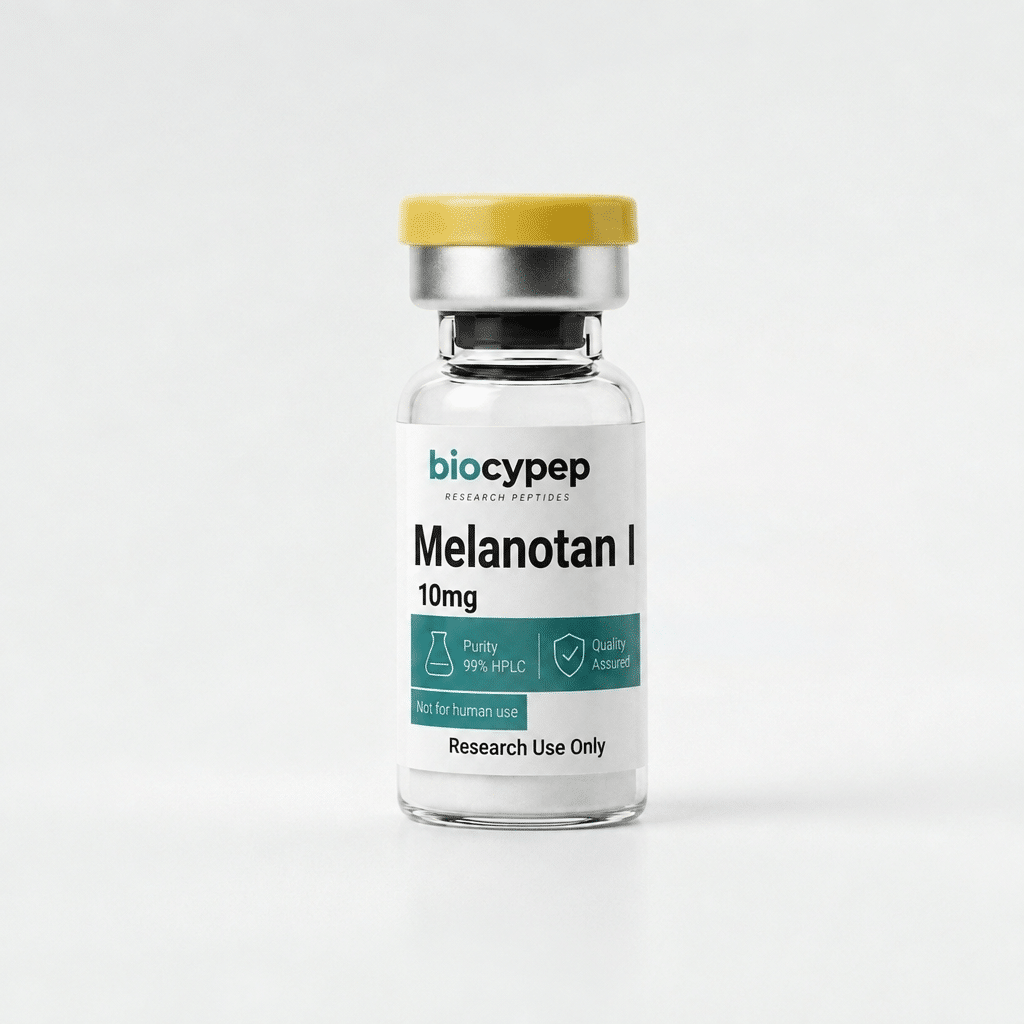

Product Information
Melanotan I (afamelanotide) is a linear synthetic analogue of alpha-MSH with high selectivity for MC1R (melanocortin-1 receptor) compared to Melanotan II. The selectivity distinction is pharmacologically significant: In research models, MT-1 primarily activates MC1R on melanocytes, driving eumelanin synthesis (melanocyte pigmentation), without the pronounced MC4R-mediated effects (e.g. arousal and broader melanocortin pathways studied in animal models) that characterize MT-2. For research isolating melanocyte biology and MC1R pharmacology from other melanocortin receptor effects, MT-1 is the more appropriate tool.
Afamelanotide has been characterized extensively in the literature: the linear alpha-MSH analogue has been studied for its MC1R-mediated photoprotective pharmacology in research models of erythropoietic protoporphyria (EPP), a photosensitivity phenotype linked to a heme synthesis defect. In such models, afamelanotide’s MC1R-mediated melanin increase has been investigated as a route to photoprotection. This body of pharmacology research provides unusually complete characterization data for a research peptide.
What is the key difference between MT-1 and MT-2?
MT-1 (afamelanotide) is a linear alpha-MSH analogue with preferential selectivity for MC1R, the melanocyte receptor that drives skin pigmentation. MT-2 (Melanotan II) is a cyclic analogue that is a non-selective melanocortin receptor agonist with significant activity at MC1R, MC3R, MC4R, and MC5R. The MC4R activity of MT-2 produces pro-erectile and appetite-suppressing effects in animal models that MT-1 largely lacks. For research specifically on melanocyte biology, photoprotection, or MC1R pharmacology, MT-1 is the more appropriate compound. For studying MC4R or mixed melanocortin receptor effects, MT-2 is used.
What is erythropoietic protoporphyria and how is MT-1 studied in that context?
Erythropoietic protoporphyria (EPP) is a rare genetic disorder caused by deficient ferrochelatase activity, leading to accumulation of protoporphyrin IX in red blood cells and skin. When protoporphyrin IX absorbs UV light, it generates reactive oxygen species that drive phototoxicity. In research on this pathway, MT-1 (afamelanotide) increases eumelanin through MC1R activation, which absorbs UV light before it reaches photosensitizing protoporphyrin molecules. This melanin-shield mechanism is the basis for studying afamelanotide as a photoprotective tool compound in EPP research models.
Is MT-1 the same as afamelanotide used in research?
Yes, Melanotan I and afamelanotide refer to the same compound. Afamelanotide is the INN (International Nonproprietary Name) used in regulatory contexts, while “Melanotan I” or “MT-1” is the commonly used research name. The compound is the same linear alpha-MSH analogue regardless of the name used. The implant formulation delivers it as a subcutaneous bioresorbable depot; research applications use the reconstituted solution.
Specifications
For research use only. Not for human or veterinary use.


